May 10, 2022
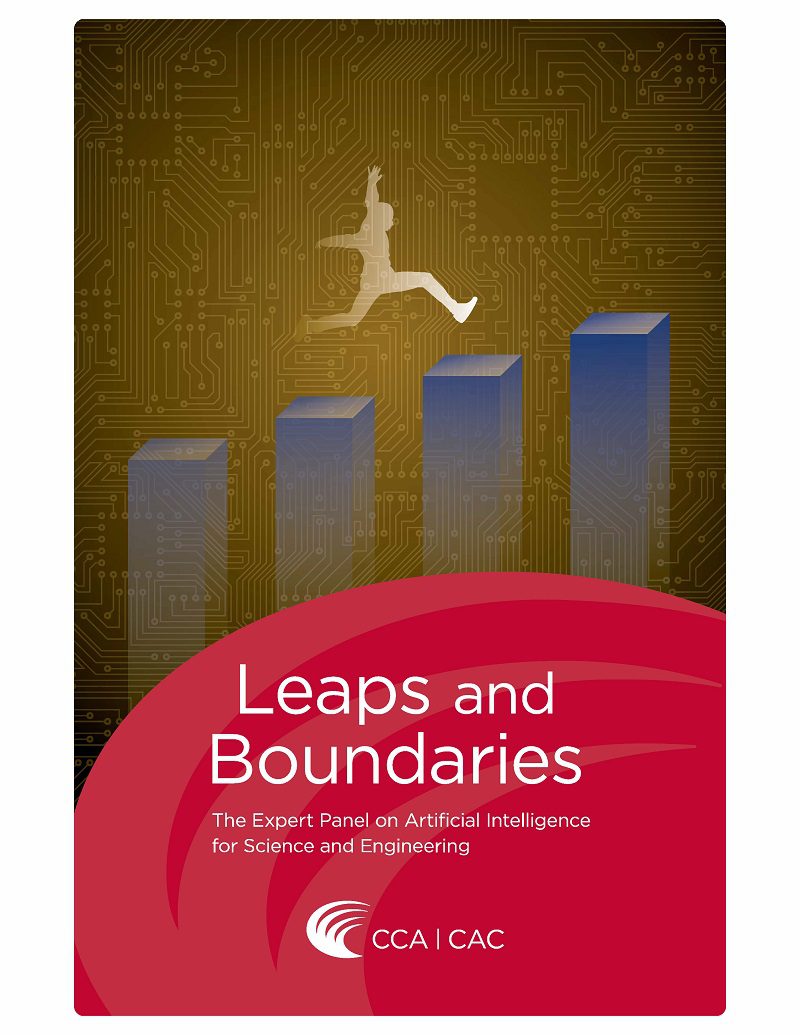
Leaps and Boundaries
The Expert Panel on Artificial Intelligence for Science and Engineering
Advances in artificial intelligence (AI) have the potential to transform the nature of scientific inquiry and lead to significant innovations in engineering. To date, AI has primarily been used alongside existing design and discovery practices to help researchers analyze or interpret data, e.g., predict the structure of proteins, track insect biodiversity, etc. However, AI will play a much bigger role in design and discovery in the near future ― developing novel scientific hypotheses and experiments and creating new engineering design processes ― all with minimal human involvement.
While AI has the potential to spur innovation and further scientific understanding beyond the limits of the human mind and abilities, it could also exacerbate inequities, perpetuate human biases, and even create new ones. Maximizing the benefits of AI and avoiding its pitfalls, will require addressing real and imminent challenges.
Leaps and Boundaries explores the opportunities, challenges, and implications of deploying AI technologies to enable scientific and engineering research design and discovery in Canada.
The sponsor:
The National Research Council of Canada (NRC), with support from the Canadian Institute for Advanced Research (CIFAR), Canadian Institutes of Health Research (CIHR), Natural Sciences and Engineering Research Council (NSERC), and Social Sciences and Humanities Research Council (SSHRC).
The question
What are the legal/regulatory, ethical, social, and policy (LESP) challenges associated with deploying AI technologies to enable scientific/engineering research design and discovery in Canada?
The Expert Panel on Artificial Intelligence for Science and Engineering